
Affiliate Disclosure: Some links in this article are affiliate links. If you buy through them, we may earn a small commission at no extra cost to you. We only recommend products we’d genuinely suggest to a friend.
Let me guess, you’re sitting in your bedroom right now, mentally placing a standing desk in the corner and hoping it doesn’t eat the whole room.
I’ve been there. And honestly, the answer most people get online is either “yes, it’ll fit” (too vague to be useful) or a wall of ergonomic specs that makes your eyes glaze over. Neither actually helps you decide.
So here’s what I’m going to do. Walk you through this the same way I’d walk a friend through it. Real measurements. Real bedroom layouts. And a straight answer at the end of each section. No fluff.
How Much Space Does a Standing Desk Actually Take Up?
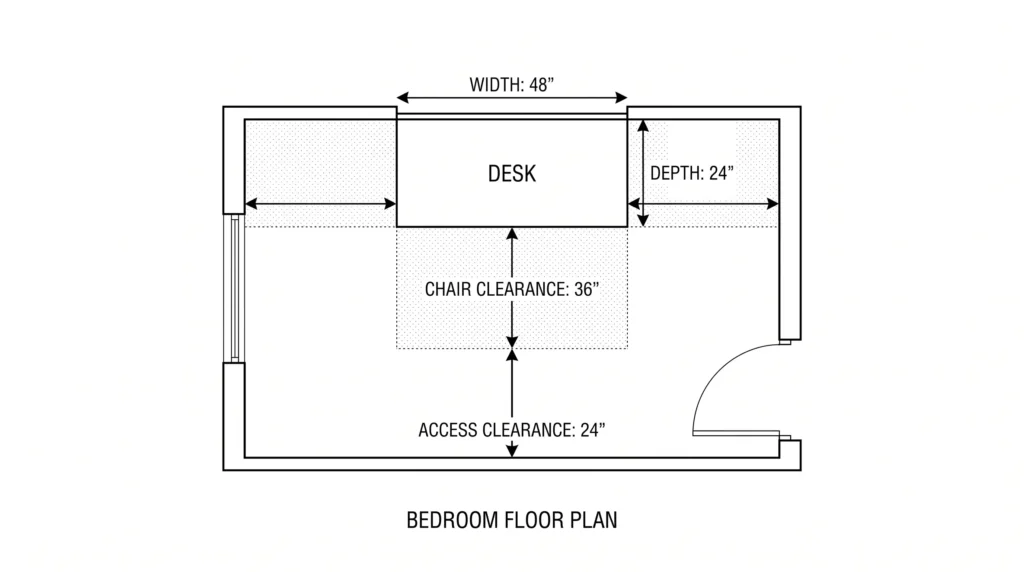
This is where most people go wrong, and I say this because I did it too. You measure the desk. You measure the wall. The numbers match. You order. Then the desk arrives, and suddenly there’s no room to actually stand at it.
Here’s the thing nobody tells you: the desk footprint is only half the equation. A standing desk needs working space in front of it. Room to stand, shift your weight, step back. That zone is just as important as the desk itself.
So before you look at desk sizes, measure these two things in your bedroom:
1. The desk footprint: width × depth of the actual desk surface
2. Your working zone: the space where YOU stand in front of it
(Both need to fit. Not just the desk.)
Here’s a realistic reference table. These aren’t “ideal” numbers. They’re the minimums where things feel functional, not cramped:
| What You’re Measuring | Minimum You Need |
|---|---|
| Desk width | 42 – 48 inches |
| Desk depth | 24 inches minimum |
| Standing clearance behind you | 24 – 30 inches |
| Side clearance (each side) | 18 inches |
| Gap between desk and bed | 24 – 36 inches |
The honest takeaway: plan for a floor zone of roughly 48″ wide × 54″ deep.
That’s desk + your standing space combined. Got that? You’re good.
Where Exactly Should You Put It?
I’ve seen people agonize over this for weeks. Here’s the real answer: you have three options, and one of them is almost always the right call for a small bedroom.
Option 1: The Corner (This Is Usually the Answer)
If your bedroom has a free corner (even a tight one), use it. Corner placement does something really smart. It creates a visual “work zone” that your brain keeps separate from your sleep space. That sounds like a soft benefit, but trust me, it matters when you’re trying to wind down at night.
Practical thing to check: when a standing desk rises to full height, it goes up to about 48 inches. Look at what’s on the wall in that corner – shelves, artwork, curtain rods. Make sure none of it is in the path of the desk surface as it travels up. I’ve seen people not notice a wall-mounted shelf until the desk frame is in place. Hit it on the first adjustment.
Option 2: Wall Opposite the Bed
This works well if your bedroom is longer than it is wide, which is the most common US bedroom layout. Place the desk along the far wall and keep at least 36 inches between the foot of your bed and the front of the desk. Less than that, and the room starts to feel like a hallway.
Option 3: Behind the Door (Seriously, Don’t Overlook This)
This is the most underused option in small bedrooms. The wall behind your bedroom door is almost always wasted space, and a 42–48 inch desk fits there without touching the usable part of your room at all. The only real downside: cables are more visible when the door is open, so you’ll want them tidy.
If you go with the behind-the-door spot, cable management becomes important fast. We tested which cable trays actually fit most standing desks.
Read: Will a Cable Tray Fit Your Standing Desk?
Real Talk: Will a Standing Desk Mess With Your Sleep?
This is the question people type at midnight and feel a little silly asking. It’s actually one of the most practical things to think through.
First, the motor noise. Most modern dual-motor desks adjust at around 45–50 decibels, which is a quiet conversation level. In a bedroom at 11 PM, it’s noticeable, but it’s not disruptive. And here’s the thing: Most people adjust their desk once in the morning and once when they’re done.
You’re not cycling it up and down while your partner is sleeping. The bigger issue is actually the monitor screen. Blue light from screens genuinely suppresses melatonin. The hormone that tells your body it’s time to sleep. If your monitor faces the bed, you’re essentially pointing a melatonin-suppressor at yourself every night.
One simple fix that actually works:
Position the desk so the BACK of the monitor faces the bed, not the screen.
That one adjustment eliminates most of the light issues. No blackout curtain needed.
A monitor arm (instead of a monitor stand) makes this even easier. You can swivel the screen toward the wall when you’re done for the day. It also frees up a surprising amount of desk surface, which matters a lot in a small bedroom setup.
Wondering if a monitor arm will actually stay stable on a standing desk?
We covered that in detail, including the wobble concern
Read: Will a Monitor Arm Make a Standing Desk Wobble?
What Size Desk Should You Actually Get for a Small Bedroom?
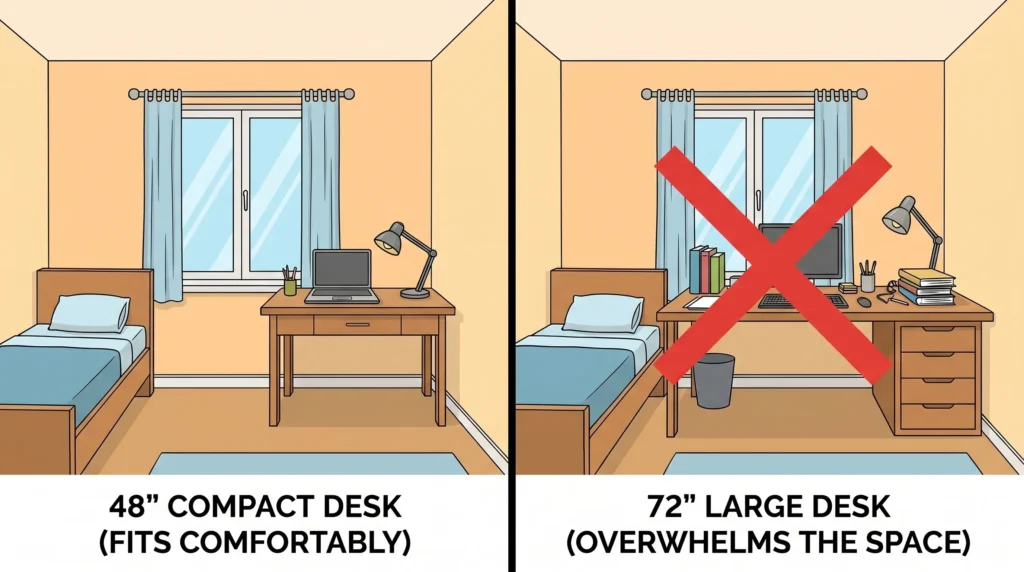
I’ll be direct here because this is where people waste the most money. Do not buy a 60 or 72-inch standing desk for a small bedroom. It will look massive in real life compared to the product photo, and you’ll be living around it instead of working at it.
Here’s a simple guide based on actual bedroom dimensions:
| Bedroom Size | Recommended Width | Depth |
|---|---|---|
| Under 100 sq ft (10×10) | 42 – 48 inches | 24 inches |
| 100–150 sq ft (10×12 – 10×15) | 48 – 55 inches | 24 – 30 inches |
| Over 150 sq ft | Up to 60 inches | 30 inches |
One thing I want to flag about is the 10 × 10 case specifically. A queen bed in a 10 × 10 room already takes up about 42 square feet. You’re working with very little floor space left. A 42–48 inch desk can fit, but placement matters a lot. Corner or behind-the-door are your only real options.
The Two Desks I’d Actually Recommend for a Bedroom Setup
I’m not going to give you a list of ten desks. You don’t need that. Here are the two that genuinely make sense for a small bedroom, and why I’d pick each one.
1. FlexiSpot E7 – 48″ × 24″
- 48″ × 24″ footprint (smallest size that’s still fully functional.)
- Dual motors: smooth, quiet, ~1.5 in/sec (not jarring in a bedroom.)
- Height range 22.8″–48.4″ (works for sitting and standing both.)
- 4 memory presets (set your heights once, never think about it again.)
- Extremely stable at full height [important on carpet (common in bedrooms.)]
- 5-year warranty (you’re not gambling on a cheap frame.)
- Best for: Anyone who wants a desk that lasts and doesn’t want to think about it again.
Check it here: FlexiSpot E7
2. VIVO Electric Compact – 40″
- Only 40″ wide (fits corners and spots where nothing else can go.)
- Single motor, lighter build (adequate for laptop or one small monitor.)
- Best option if your budget is under $300.
- Good if you work primarily from a laptop and need minimal desk space.
- Best for: Very small bedrooms, studio apartments, or laptop-only setups.
Check the Current Price on Amazon
One thing most bedroom buyers don’t expect. Carpet makes standing desks wobble.
Most US bedrooms have carpet. If yours does, read this first.
Read: Why Does My Standing Desk Wobble on Carpet?
Before You Order: Your 5-Step Bedroom Measurement Checklist
Grab a tape measure. This takes five minutes and has saved a lot of people from a very annoying return shipping experience
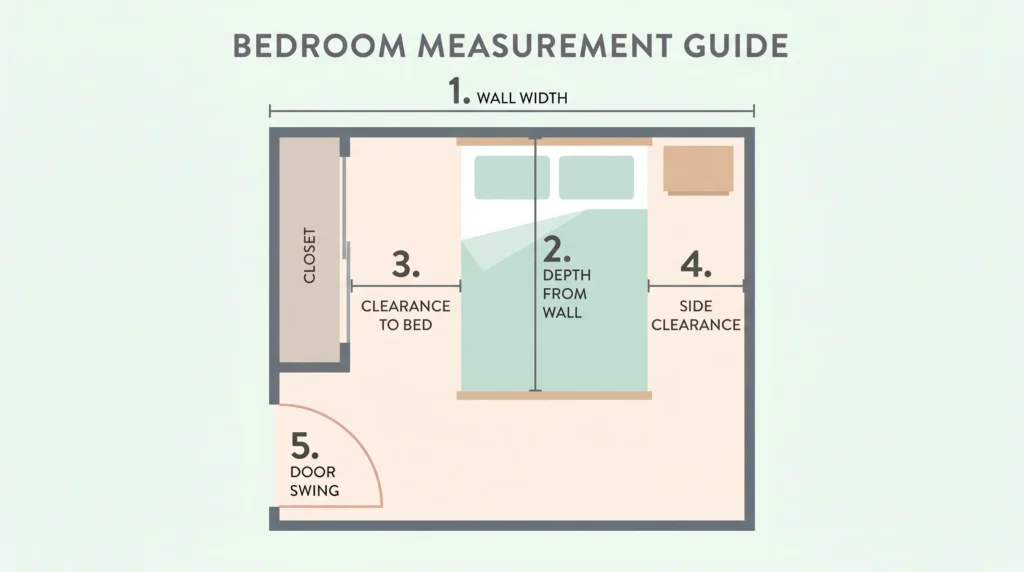
1. Measure your wall width:
Measure the wall where the desk will go. Subtract 6 inches on each side. That remainder is your maximum desk width; don’t exceed it.
2. Measure depth from the wall to the first obstacle:
How far from the wall before you hit the bed, closet door, or walking path? Your desk depth PLUS 24-30 inches of standing space must fit here.
3. Check clearance from desk to bed:
You need at least 24 inches between the front edge of the desk and the nearest side of the bed. 36 inches feels comfortable. Measure it now, don’t guess.
4. Check your door swing:
Open your bedroom door all the way. Does it swing into where the desk would go? This catches a lot of people off guard and it’s a miserable thing to discover after the desk is assembled.
5. Check the delivery path into your room:
A 48-inch desktop ships as one flat panel. Standard US interior doors are 28–32 inches wide. The panel goes in at an angle. A 60-inch desktop may not fit through your doorframe without removing it first. Amazon won’t tell you that.
Summary:
Quick Summary (Everything You Need to Know):
● Plan for a floor zone of 48″ wide by 54″ deep, because that covers both the desk and your standing space.
● Corner placement is almost always the best call in a small bedroom.
● Position the monitor screen away from the bed. Your sleep will thank you.
● For most small bedrooms, the FlexiSpot E7 (48″) is the long-term choice worth investing in.
● Very tight space or tight budget? The VIVO Electric Compact (40″) gets the job done.
● Measure 5 things before ordering, and pay special attention to the delivery path into your room.
● Most US bedrooms have carpet, so check our wobble guide before you set up.
Still not sure if it’ll fit your bedroom?
We get it. Every bedroom layout is a little different, and no two floor plans are exactly alike. If you’ve measured everything and you’re still second-guessing yourself, send us a message through our contact form.
Tell us your room dimensions, and we’ll figure it out with you.
FAQ:
Q. What’s the smallest bedroom a standing desk realistically fits in?
Q. Is it actually bad to have a desk in your bedroom?
Q. How much clearance do I need behind me when standing?
Q: Can a 40-inch standing desk actually work, or is it too small?
Q: Do standing desk motors make noise? Will it wake someone up?
Q: What’s the best standing desk for a bedroom under $300?

I got interested in home office setups and noticed most buying guides online tell you if a product is ‘good,’ but never tell you if it will actually fit your specific desk. Does It Fit My Team exists to close that gap, with real measurements, verified sources, and straight answers.